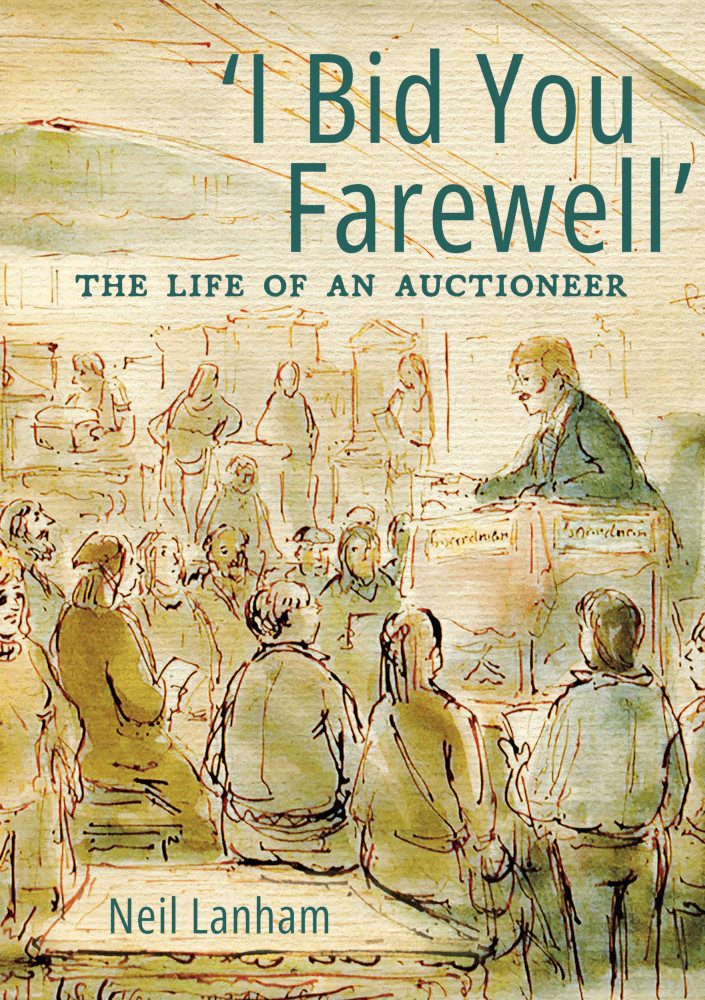
‘I Bid You Farewell’ The Life Of An Auctioneer by Neil Lanham
Buy on Amazon UK or Waterstones.
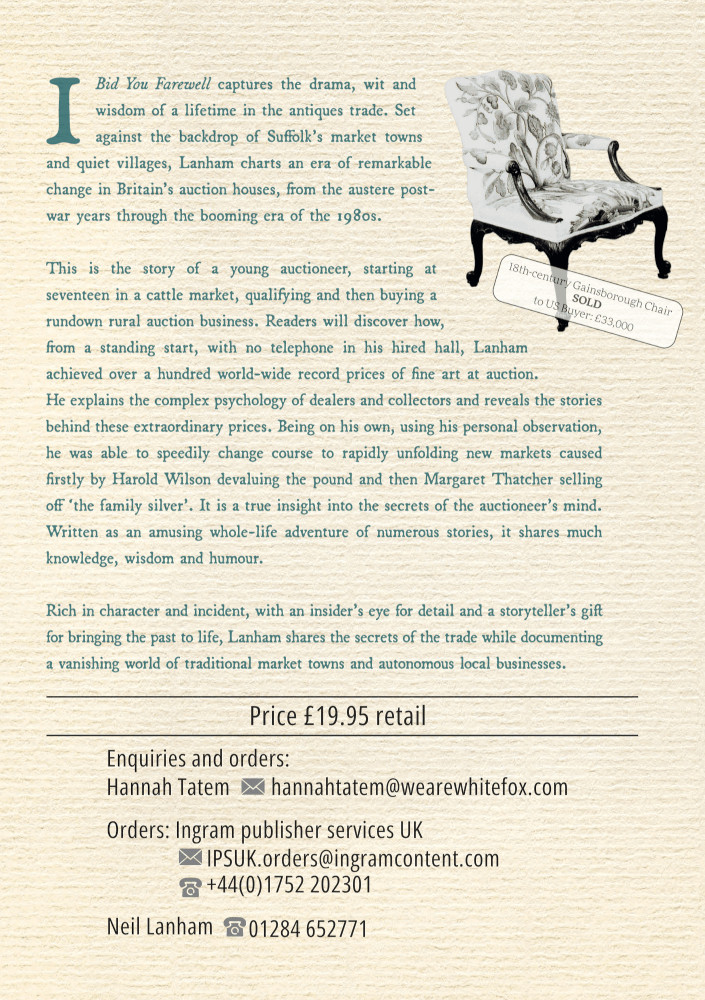
I Bid You Farewell captures the drama, wit and wisdom of a lifetime in the antiques trade. Set against the backdrop of Suffolk’s market towns and quiet villages, Lanham charts an era of remarkable change in Britain’s auction houses, from the austere post-war years through the booming era of the 1980s.
This is the story of a young auctioneer, starting at seventeen in a cattle market, qualifying and then buying a rundown rural auction business. Readers will discover how, from a standing start, with no telephone in his hired hall, Lanham achieved over a hundred world-wide record prices of fine art at auction. He explains the complex psychology of dealers and collectors and reveals the stories behind these extraordinary prices. Being on his own, using his personal observation, he was able to speedily change course to rapidly unfolding new markets caused firstly by Harold Wilson devaluing the pound and then Margaret Thatcher selling off ‘the family silver’. It is a true insight into the secrets of the auctioneer’s mind. Written as an amusing whole-life adventure of numerous stories, it shares much knowledge, wisdom and humour.
Rich in character and incident, with an insider’s eye for detail and a storyteller’s gift for bringing the past to life, Lanham shares the secrets of the trade while documenting a vanishing world of traditional market towns and autonomous local businesses.
Price £24.95 retail
Enquiries and orders
Hannah Tatem hannahtatem@wearewhitefox.com
Orders: Ingram publisher services UK IPSUK.orders@ingramcontent.com +44(0)1752 202301
Neil Lanham 01284 652771
Buy on Amazon UK or Waterstones.
Brief Synopsis:
In 1967 Prime Minister Harold Wilson devalued the Pound by 14%. The young Neil Lanham who had purchased Boardmans, a Suffolk firm of general auctioneers in 1962, recognised that this gave dealers from Europe a 14% advantage so advertising in European magazines he found that he could tap into a new level of auction prices achieved from Dutch, German, and Belgian dealers who would bid against one another, causing in many instances prices to double.
The demand was mainly for Oak and early pieces and he was soon holding the largest sales of these goods in Europe. ‘I believe that we were the first auctioneers, by quite a long way, to recognise the coming change’ he says.
‘Boardmans was my firm, I had no partners, but I had fresh ideas, and an abundance of enthusiasm and being on my own could arrogantly do what I liked’ says Neil ‘At a time when there was no telephone in our hired hall saleroom but we were able to make a world record price of £32,000 for an 18th century French commode. We believed that his was £12,000 above the previous highest price’ he says. This was followed by a 17th century Dutch Oak cupboard from a Cambridge College that almost doubled the record price for a piece of oak at auction, at £33,000.
This and what was to follow shocked the establishment. We almost always made more money in sleepy Suffolk for good period furniture, than they made for the equivalent in the major London Auction Houses and I have gone to great lengths to explain the phycology behind our success. Over one hundred world record prices at auction were achieved at our Suffolk auctions and here I share the reasons why and how behind the price of each piece’. This whole life celebration of an auctioneer’s life make a humorously captivating read


Picture notes: The painted chest is 17c Pennsylvania American. It originally cost the equivalent of £10,000 in USA – we sold it to go back to America for £22,000 at Clare. The 2 chairs are 18c mahogany gothic Chippendale from a set of 12 we sold them to a New York buyer for £85,000 and the 17c Dutch carved Oak Cupboard sold for £32,000.
Buy the book on Amazon UK or Waterstones.